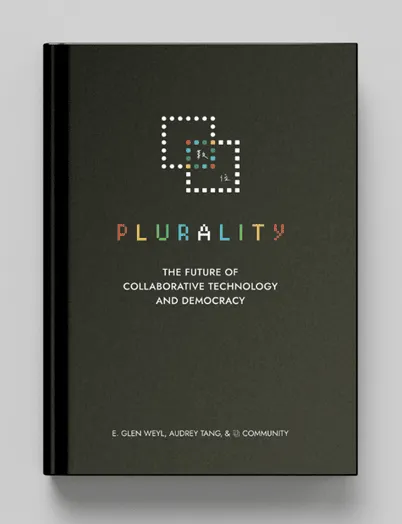
Why this book
Plurality is the most comprehensive recent argument that digital democracy is neither a monist project (let AI optimize policy) nor an atomist one (let markets and crypto sort it out), but a third path — ⿻ — that recognizes partially-overlapping social groups and intersectional identities as the substrate of legitimate collective decisions. Weyl and Tang back the argument with a decade of working civic tech: vTaiwan, Polis, g0v, JOIN, presidential hackathons, quadratic funding, augmented deliberation. The book ships under CC0, and the authors actively want it to be remixed and applied.
What we built
A 13-tool MCP server that makes Plurality’s catalog callable — cases, failure modes, design moves, policy strategies, and verbatim quotes, all indexed for an agent that’s working through a real situation rather than researching in the abstract. The catalog covers the Taiwan civic-tech canon and the global ⿻ scene — vTaiwan, Polis-style cross-faction consensus, g0v hackathons, Decidim Barcelona, Estonia’s e-government, Iceland’s crowdsourced constitution, Gitcoin quadratic funding, Wikipedia, OpenStreetMap, Mastodon — alongside the failure modes the book names (monist technocracy, atomist libertarianism, engagement-maximization, captured-DAO plutocracy) and the design moves it argues for (quadratic and plural voting, augmented deliberation, intersectional social identity, social markets, federated subsidiarity, data unions).
What’s in the catalog
- Cases — civic-tech and digital-democracy examples Plurality documents (Taiwan-centric + global).
- Failure modes — counter-⿻ patterns and the historical instances that exemplify them (the “monist” and “atomist” failure modes are the book’s central diagnostic).
- Governance forms — ⿻ primitives with diagnostic questions (quadratic voting, augmented deliberation, polis-clustering, conviction voting, partial common ownership, depreciating licenses, data unions, etc.).
- Policy strategies — scaled moves at the policy/regulatory level (digital ministries, public-interest media funding, antitrust as ⿻, public-option platforms, data-union frameworks).
- Glossary — the book’s vocabulary (⿻, augmented deliberation, post-symbolic communication, intersectional social identity, plurality publics, Yushan view, lost dao, monist, atomist, g0v).
- Quotes — themed verbatim passages indexed for citation. The book is CC0 — no license restrictions — but quotes carry attribution as a scholarly norm.
What you can ask
- “Help me write up vTaiwan as a case study, grounded in the book’s framing”
- “Is this AI-policy proposal ⿻ or monist? Walk it through the diagnostic”
- “I’m designing a city-budget deliberation platform — what does Plurality say about layering identity, association, deliberation, voting, and markets?”
- “Reframe ‘free markets solve coordination’ in ⿻ terms”
- “What does the book mean by ‘intersectional social identity’?”
- “Find me a passage on the Yushan view”
- “What policy moves would scale digital democracy across cities?”
License
Plurality is dedicated to the public domain under CC0 1.0. The server code is MIT. Re-use freely; attribution to the authors is included as a scholarly norm.
Related
- Governable Spaces — Schneider’s framing of democratic design for online life. Strong complement on the diagnostic side (implicit feudalism in platforms, federation as response).
- Think Like a Commoner — Bollier’s commons framing. Adjacent vocabulary (the commons as a different cut at the same “neither monist nor atomist” question).
MCP server
plurality-mcp
Claude Desktop
Open Customize → Connectors, select Add custom connector, and enter this server URL:
https://plurality-mcp-production.up.railway.app/mcpName it plurality, finish connecting it, then enable it from + → Connectors in a conversation.
Claude Code
Run from your terminal:
claude mcp add --scope user --transport http plurality https://plurality-mcp-production.up.railway.app/mcpRestart your Claude Code session. claude mcp list should show the server connected.
- Source on GitHub →
https://plurality-mcp-production.up.railway.app/mcp