Think Like a Commoner
Why this book
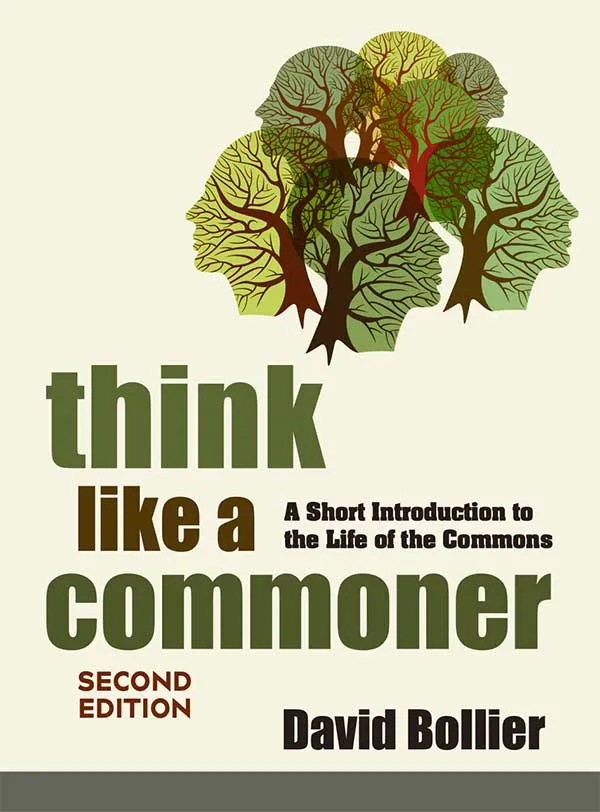
Bollier wrote Think Like a Commoner as a short, structured introduction to the commons — not the textbook caricature (a resource that gets depleted because it’s “free for everyone”), but the working sense the word has carried for centuries: a community of stewards, a body of social protocols, and the wealth they care for together.
Bollier walks Elinor Ostrom’s eight design principles for self-governing commons, names a working catalog of commoning practices around the world, and gives the moves of enclosure — financialization, commodification, “commons-washing” — explicit names so practitioners can call them out. He treats the commons as a living social system, not a resource to be managed. The book is brief, but each chapter is load-bearing.
A practitioner drafting a co-op charter, designing a community land trust, or naming an extraction pattern doesn’t need to read the whole book on demand. They need Bollier’s framing scoped to their question, with the chapter intact.
What we built
think-like-a-commoner-mcp — an MCP server that exposes the book’s content as 12 callable tools, grouped by job:
- Routing.
start_analysisis the branching entry point — it scaffolds an analysis based on what kind of situation you’re in (threatened commons, designing a commons, naming an enclosure, just exploring) and points at the next tools to call.suggest_next_stepkeeps the flow going. - Diagnostic.
classify_situation,find_enclosure_pattern,find_precedent_commons,list_response_strategies. - Design.
assess_ostrom_principles(against all eight),find_similar_commons,suggest_commoning_protocols. - Reference.
apply_ontoshift,get_glossary_term,find_quote.
Every return value carries a citation — chapter, sometimes a verbatim source quote — back to the book.
What’s in the catalog
Six structured stores, extracted directly from the book:
- Commons cases. Living examples Bollier names — from acequia irrigation associations to community land trusts, makerspaces, blood-donation gift economies, language as commons, mesh-network WiFi, Indigenous commitment-pooling traditions, platform cooperatives. Each entry carries the source chapter, the kind of care-wealth involved, the community that holds it, and the protocols (in Bollier’s MUST / SHOULD framing) the case demonstrates.
- Ostrom’s eight design principles. Each principle has its full description, a set of diagnostic questions, and the example commons that illustrate it (Törbel alpine commons since 1224, Spanish huerta irrigation, Los Angeles groundwater management).
- Enclosure patterns. Named patterns of dispossession — privatization, financialization of nature, commons-washing, market/state duopoly lock-in, cultural erasure of commons language — paired with the counter-strategies the book proposes.
- Response strategies. Commoning practices Bollier names: building a parallel polis, vernacular law, commons-based peer production, self-organized resource governance — with the situations they fit and the case examples that ground them.
- Glossary. Bollier’s working vocabulary, defined as he uses it: commoning, commons-washing, parallel polis, OntoShift, vernacular law, commonsverse, neo-extractivism, financialization of nature.
- Verbatim quotes. Source-located passages — for citation, framing, or a writer who wants Bollier’s exact language.
What you can ask
The tools are designed for chained workflows. Some real shapes:
Naming an enclosure. “Our city is selling off its public WiFi infrastructure to a telco. Help me write a piece naming what’s being lost.” → start_analysis(situation: "naming_enclosure") → classify_situation(...) → find_enclosure_pattern(...) → list_response_strategies(...) → find_quote("financialization") for the closing.
Designing a commons. “We’re drafting a co-op charter for shared agricultural land. What design principles should we install, and what’s a working precedent?” → start_analysis(situation: "designing_commons") → assess_ostrom_principles(...) → find_similar_commons(...) → suggest_commoning_protocols(...).
Writing on the commons. “I need a Bollier passage for a piece on language itself as a commons.” → find_quote("language as commons") returns the passage with its source location; get_glossary_term("commoning") returns Bollier’s working definition for the same piece.
License
Source code: MIT. Embedded book content (catalogs, glossary, quotes): CC BY-NC-SA 4.0 — attribution to David Bollier required, non-commercial only.
Read the book free at thinklikeacommoner.com or order from New Society Publishers.
Related
- Governable Spaces — Schneider’s framing of democratic design for online life. Different territory (digital communities) but adjacent move: a structured catalog of failure modes and counter-forms, with citations.
MCP server
think-like-a-commoner-mcp
Claude Desktop
Open Customize → Connectors, select Add custom connector, and enter this server URL:
https://tlac-book-mcp-production.up.railway.app/mcpName it think-like-a-commoner, finish connecting it, then enable it from + → Connectors in a conversation.
Claude Code
Run from your terminal:
claude mcp add --scope user --transport http think-like-a-commoner https://tlac-book-mcp-production.up.railway.app/mcpRestart your Claude Code session. claude mcp list should show the server connected.
- Source on GitHub →
https://tlac-book-mcp-production.up.railway.app/mcp