Governable Spaces
Why this book
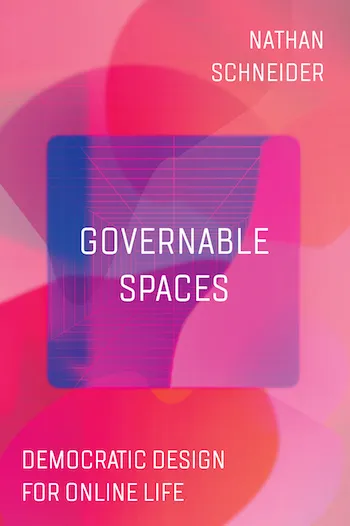
Schneider opened Governable Spaces with a question anyone who has spent time in a moderated platform will recognize: why does so much of online life feel feudal? You spend years in a community — follow the norms, earn trust, contribute. Then a single owner — a Discord admin, a subreddit founder, a platform CEO, a multisig holder — makes a unilateral move that affects everyone, with no formal seat at the table for the people who actually live in that space.
Schneider names this pattern implicit feudalism: not a slogan, a diagnosable structure. A platform governed by a single owner with unchecked, arbitrary power; no meaningful voice, exit, or ownership stake for members; rules imposed top-down without democratic legitimacy. The book is a working argument that implicit feudalism is the default of digital life — and that the alternative, a governable space, has to be deliberately designed.
He’s not a doomer about it. Governable Spaces catalogs democratic mediums that work: Wikipedia, Mastodon and the wider fediverse, Loomio, Decidim, the Drupal community, parts of the Ethereum ecosystem. The design primitives he names — sortition, federated subsidiarity, plural voting, modular politics, metagovernance — compose into workable counter-patterns. The moves that close down democracy (the politics of no politics, digital colonialism, captured-DAO plutocracy) get explicit names so practitioners can call them out.
Practitioners working on a co-op platform, a fediverse instance, a DAO migration, or a research-community charter don’t need to read the whole book on demand. They need Schneider’s framing scoped to their question, with the chapter intact.
What we built
governable-spaces-mcp — an MCP server that exposes the book’s content as 13 callable tools, grouped by job:
- Routing.
start_analysis(a branching entry point that scaffolds an analysis from the situation: diagnosing implicit feudalism, designing a governable space, finding precedent, exploring) andsuggest_next_step. - Diagnostic.
diagnose_implicit_feudalism,find_failure_mode,find_precedent_case,list_policy_strategies. - Design.
assess_governable_space,find_similar_case,suggest_governance_forms. - Reference.
apply_democratic_mediation,get_glossary_term,find_quote,search_book.
Every return value carries a citation back to the book.
What’s in the catalog
Six structured stores, organized around Schneider’s central distinction between governable spaces and implicit feudalism:
- Cases. Democratic-medium examples Schneider documents — Wikipedia, the fediverse, Loomio, Decidim, the Drupal community, the Ethereum DAO ecosystem, Porto Alegre participatory budgeting. Each entry names its community (who participates), the governance forms it uses, and concrete democratic features with MUST / SHOULD / MUST NOT modal markers drawn directly from Schneider’s framing.
- Failure modes. Recurring counter-democratic patterns (implicit feudalism, politics of no politics, digital colonialism, captured-DAO plutocracy, BDFL dictatorship, affective-voice-without-effective-voice) plus specific historical instances Schneider names (the 2023 Reddit API revolt, Twitter’s acquisition). Each has a
kinddiscriminator (pattern or instance) and cross-references the governance forms that counter it. - Governance forms. Democratic primitives with diagnostic questions: representational voting, sortition, federated subsidiarity, plural voting (quadratic and weighted), consensus decision-making, modular politics, metagovernance, participatory budgeting, bylaws-based community self-governance. Each lists which failure modes it counters and which cases exemplify it.
- Policy strategies. Scaled moves that embed democratic design at the policy / regulatory level: governable-stack acts, antitrust as democracy-tech, public-option mandates, platform-cooperative tax incentives, exit-to-community securities reform.
- Glossary. Schneider’s vocabulary, defined as he uses it: implicit feudalism, governable space, governable stack, modular politics, democratic mediation, metagovernance, politics of no politics, digital colonialism.
- Verbatim quotes. Source-located passages indexed by theme, with attribution to Schneider built into every response — for citation, framing, or a writer who wants the exact language.
Example democratic feature, from the Wikipedia entry: “Editors MUST reach consensus or supermajority before major content or policy changes take effect.”
What you can ask
The tools chain. Some real shapes:
Diagnosing implicit feudalism. “Help me write up the 2023 Reddit API revolt as a case study, grounded in real framing.” → start_analysis(situation: "diagnose_feudalism") → find_failure_mode(...) → suggest_governance_forms(countering_failure_mode_id: "implicit-feudalism") → find_quote("implicit feudalism") for the closing.
Designing a governable space. “I’m starting a small federated discussion platform for environmental researchers — 200 people across a few institutions. How do I design this as a governable space, not yet another admin-run forum?” → start_analysis(situation: "design_governable_space") → assess_governable_space(...) → find_similar_case(...) → suggest_governance_forms(...).
Naming a pattern. “I’m seeing reaction-emoji used as a proxy for vote without binding effect. What does Schneider call this?” → find_failure_mode(signs: ["reaction-emoji as vote"]) → get_glossary_term(...) → find_quote(...).
License
Source code: MIT. Embedded book content: CC BY-NC-SA 4.0 — attribution to Nathan Schneider required, non-commercial only.
The book is open access via Luminos, UC Press’s open imprint.
Related
- Think Like a Commoner — Bollier’s commons framing. Different territory (resource commons + commoning practice) but adjacent move: a structured catalog of cases, design principles, and counter-strategies, with citations.
MCP server
governable-spaces-mcp
Claude Desktop
Open Customize → Connectors, select Add custom connector, and enter this server URL:
https://governable-spaces-mcp-production.up.railway.app/mcpName it governable-spaces, finish connecting it, then enable it from + → Connectors in a conversation.
Claude Code
Run from your terminal:
claude mcp add --scope user --transport http governable-spaces https://governable-spaces-mcp-production.up.railway.app/mcpRestart your Claude Code session. claude mcp list should show the server connected.
- Source on GitHub →
https://governable-spaces-mcp-production.up.railway.app/mcp