Democracy Without Politicians
Why this book
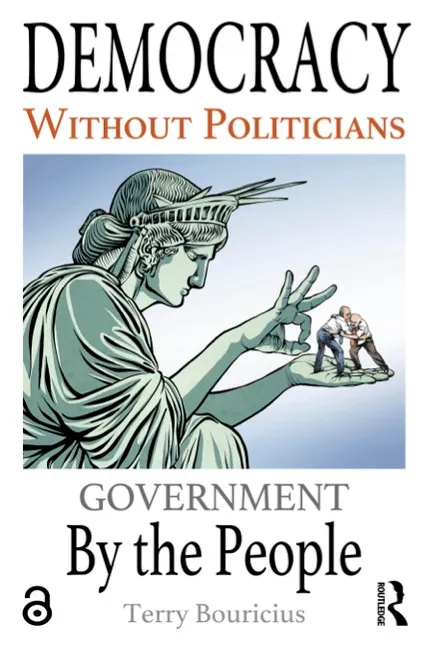
Democracy Without Politicians is a former elected politician’s case against his own trade. Terry Bouricius argues that electoral “democracy” is inherently undemocratic — it enshrines rule by a political class rather than genuine popular self-rule — and that the usual reforms (proportional representation, campaign-finance limits, ranked ballots) can’t fix what elections structurally do. His alternative is sortition: forming representative deliberative bodies by lot, the way Athens did and the way modern citizens’ assemblies do.
The book’s centrepiece is a worked design — multi-body sortition (Ch. 16): not one citizens’ jury but a system of specialised, randomly-selected bodies that set the agenda, hear interests, draft, decide, coordinate, and oversee. It runs from the cognitive and psychological case against elections, through the history of sortition from ancient Greece to Ostbelgien, to a concrete transition path.
A practitioner designing a citizens’ assembly, a sortition pilot, or a deliberative process doesn’t need the whole book in context. They need Bouricius’s argument, scoped to their question, in his own words.
What we built
This one is built differently from its catalog siblings. The book is CC BY-NC-ND, and Bouricius gave permission on one condition: the tool must find relevant text and display his actual words, not AI-generated summaries. So democracy-without-politicians-mcp is a verbatim search-and-read server — every one of its 10 tools returns passages straight from the book, with attribution, never a paraphrase. A build test asserts that every excerpt any tool can return is a verbatim substring of the source.
- Read it.
get_book_info,list_chapters,get_chapter(verbatim text, paginated),get_chapter_highlights. - Search it.
search_content— keyword search returning the most relevant verbatim paragraphs with their chapter. - Navigate it.
get_principles(12 key topics),get_multi_body_design(the seven bodies of Ch. 16),get_glossary+define_term(the terms he coins),find_cases(the real assemblies he cites). Each is a curated label that resolves to a verbatim excerpt at request time — the label orients you, the substance is always Bouricius’s own words.
What’s in the catalog
Five navigation layers, each a set of labels that resolve to Bouricius’s verbatim text:
- The 17 chapters — from “Democracy in Dysfunction” and “The Inadequacy of Election Reform” through “The Sortition Solution,” “Objections to Sortition,” and “A Transition to Sortition Democracy.” Readable in full, paginated.
- 12 key topics (
get_principles) — the book’s load-bearing arguments (the electoral imperative, neuro-politics, accountability and legitimacy, the re-emergence of sortition), each returning the passage that makes the point. - The multi-body design (
get_multi_body_design) — the seven specialised bodies of Chapter 16: Agenda Council, Interest Panels, Review Panels, Policy Juries, Coordination Council, Rules Council, Oversight Councils. - ~20 glossary terms (
get_glossary/define_term) — the vocabulary he coins or leans on, each resolving to the passage where he introduces it. - The cases he cites (
find_cases) — Ancient Athens, Ostbelgien, the British Columbia Citizens’ Assembly, the Paris assembly, deliberative polls, and more, each with the excerpt where he discusses it.
What you can ask
Plain questions; the agent calls a tool and hands back Bouricius’s own words:
- “What’s Bouricius’s case that election reform can’t fix democracy?” →
search_content→ the verbatim passages, cited to chapter. - “Show me the difference between Review Panels and Policy Juries in his multi-body design.” →
get_multi_body_design→ the Chapter 16 excerpts for each body. - “How does he answer the objection that ordinary people aren’t competent to govern?” →
get_chapteron “Objections to Sortition,” orsearch_content.
License
Source code: MIT. Embedded book text: CC BY-NC-ND 4.0 — attribution to Terry Bouricius required, non-commercial, no derivatives. The server honours that by returning verbatim passages only; nothing is paraphrased. Shared with the author’s express permission (2026-06-23).
The book is open access at Taylor & Francis.
Related
- Governable Spaces — Schneider names sortition as one democratic primitive among many for online life; Bouricius makes it the whole architecture of government.
- Facilitating Deliberation — once sortition has selected the panel, this is the practitioner’s craft of running the deliberation itself.
MCP server
democracy-without-politicians-mcp
Claude Desktop
Open Customize → Connectors, select Add custom connector, and enter this server URL:
https://democracy-without-politicians-mcp-production.up.railway.app/mcpName it democracy-without-politicians, finish connecting it, then enable it from + → Connectors in a conversation.
Claude Code
Run from your terminal:
claude mcp add --scope user --transport http democracy-without-politicians https://democracy-without-politicians-mcp-production.up.railway.app/mcpRestart your Claude Code session. claude mcp list should show the server connected.
- Source on GitHub →
https://democracy-without-politicians-mcp-production.up.railway.app/mcp